
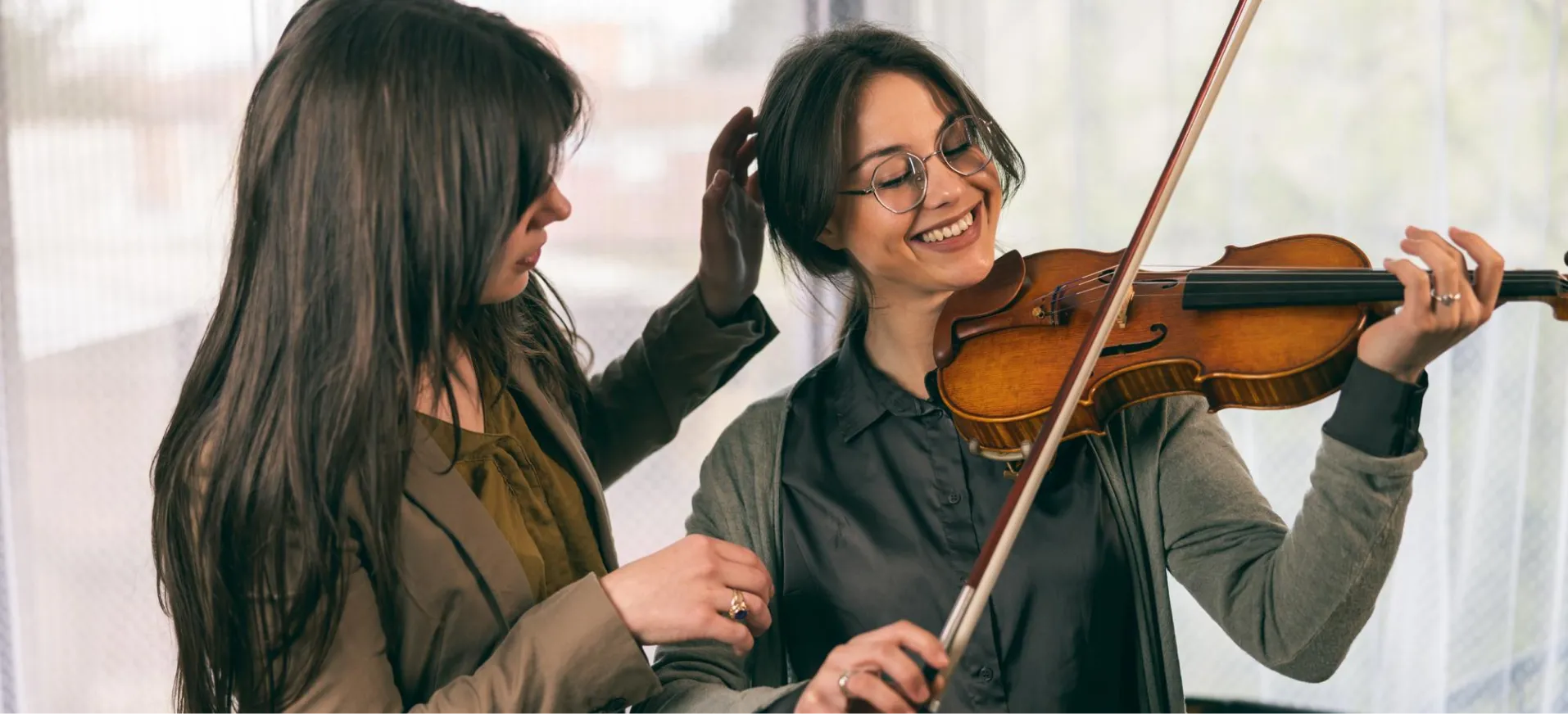

What the Music Group Is
It is a music session inside Sol’s women-only outpatient program in Riverside, running across three levels of care. Instruments, listening, playing, and room to talk about what came up if you want to. It runs alongside the clinical treatment rather than as a substitute for it.
Music groups are led by our program staff, not a board-certified music therapist; they’re a gentle, creative part of the week.
What Actually Happens

There are instruments and there is a speaker. Some weeks the group plays, some weeks it listens, some weeks a woman brings the song she cannot get through without crying and the room sits with it.
You do not need to play anything, read music or have any background in it. Nobody is auditioning and there is no performance at the end.
What follows the music is the part women tend to remember: something is easier to say after a song than before one. The staff member running the group is there to hold the room rather than to interpret what you played, and nothing you choose is read as a diagnosis.
For many women, the value is simple: it is an hour in the treatment week that offers a gentle break from talking.
About the Research on Music Therapy

The National Center for Complementary and Integrative Health, part of the National Institutes of Health, defines music therapy as a health profession in which music is used within a therapeutic relationship to address physical, emotional, cognitive and social needs.1 A health profession. A therapeutic relationship. In the United States that generally means a board-certified music therapist, and it is that relationship the research is actually testing.
Our music group is led by program staff, so the published research on music therapy describes a different service. For that reason, we do not use those findings to describe our group.
We make no claim that the music group reduces cravings, treats depression, lowers anxiety or supports sobriety. It is simply a warm, creative part of the week.
On safety, NCCIH reports that in general, research studies of music-based interventions do not show any negative effects, noting only that listening at too high a volume can contribute to noise-induced hearing loss.1
Where It Sits in Your Treatment
The music group runs alongside your treatment, never instead of it.
The clinical work is CBT, EMDR where trauma is central, the group program, DBT skills, acceptance and commitment therapy groups, and medication management, which is included for every client.
What the music group adds, for the women who value it, is a way into feelings that are hard to reach in conversation, and an hour that is not more talking. It is a meaningful part of the week alongside your clinical care.
Starting Treatment
1
Call or Send Your Insurance Details
Admissions answers 24 hours a day, seven days a week.
2
Assessment
A clinician works out what is being treated and which level of care fits.
3
Verify Your Insurance
We contact your plan and walk you through your benefits.
4
Start Date
Set around what your week can hold.
You do not need to play anything, read music, or have any musical background. Nobody is auditioning.
In crisis right now? Call or text 988.
Frequently Asked Questions
Our admissions line is answered 24 hours a day, 7 days a week at (951) 972-5085.

Is This Music Therapy, and Who Runs It?
It is a music group. Music groups are led by our program staff, not a board-certified music therapist; they’re a gentle, creative part of the week. NCCIH defines music therapy as a health profession in which music is used within a therapeutic relationship, so we call ours a music group.
Why Does This Page Not Cite Any Research?
Because the research on music therapy studies sessions delivered by trained music therapists inside a therapeutic relationship, and our group is led by program staff. Those findings describe a different service, so we do not borrow them.
Does the Music Group Help With Cravings, Depression or Anxiety?
We make no claim that it does. Those findings come from research on credentialed music therapy. Our music group is a gentle hour in the week that is not more talking, in a room of women only.
Do I Need to Be Musical?
No. You do not need to play anything, read music or have any background in it. There is no performance and nobody is auditioning.
Is It Safe?
NCCIH reports that in general, research studies of music-based interventions do not show any negative effects, with the only noted caution being that listening at too high a volume can contribute to noise-induced hearing loss. If a song or a session brings something up, tell your clinician. That is useful information about what is being treated, not a sign you did it wrong.
What Is Actually Doing the Treating at Sol?
CBT, EMDR where trauma is central, the group program, DBT skills, acceptance and commitment therapy groups, and medication management, which is included for every client. The music group sits alongside all of that.
Does Insurance Cover the Music Group?
It is part of your program rather than billed separately, so what matters is how your plan covers your level of care. Sol accepts most major insurance plans, including Aetna, Anthem, Blue Cross Blue Shield, Carelon, CareFirst, Cigna, UC SHIP and UnitedHealthcare. Sol can often work with HMO policies through a single case agreement. Sol does not accept Medi-Cal, Medicaid, Medicare, Molina, IEHP, Kaiser, TRICARE or TriWest. Every plan is different, so the quickest way to know is to verify your insurance. Our admissions team responds within 24 hours.
Show all 7 questions

A Gentle Change of Pace in Your Week
It sits alongside your treatment, and many women find it a restful, creative part of the week.
4175 Brockton Avenue, Riverside, CA 92501
Confidential. No musical ability required or expected.
Sources1
- 1.National Center for Complementary and Integrative Health, National Institutes of Health. Music and Health: What You Need To Know. https://www.nccih.nih.gov/health/music-and-health-what-you-need-to-know
Medical Disclaimer
This page is educational and is not medical advice. The music group at Sol Women’s Treatment is run by program staff rather than by a board-certified music therapist, runs alongside clinical treatment, and is not a treatment for any condition on its own. Sol does not provide clinical music therapy. Sol is certified by the California Department of Health Care Services for outpatient and intensive outpatient services, certification 330246AP, and licensed by the California Department of Social Services, facility 331881576, and does not provide detox, inpatient or residential care. No two women respond identically and nothing here promises a result. In a medical emergency call 911. If you are in crisis, call or text 988.