
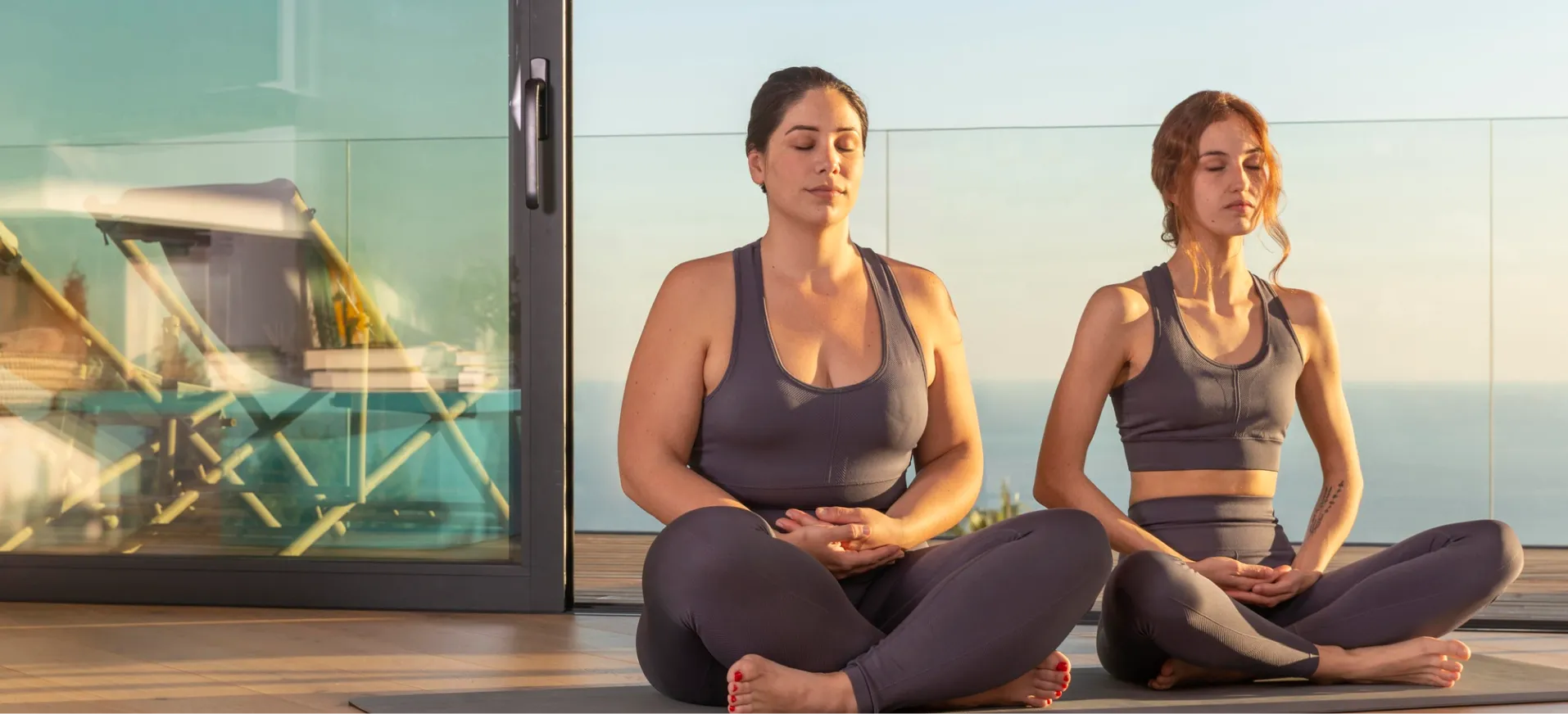
Sol’s Women’s Wellness Program is the name for the body-based part of the week inside Sol’s women-only outpatient treatment in Riverside: yoga, breathing practice, sound sessions, movement, and the female wellness panel. These run alongside the clinical work, not instead of it, as part of your treatment week.
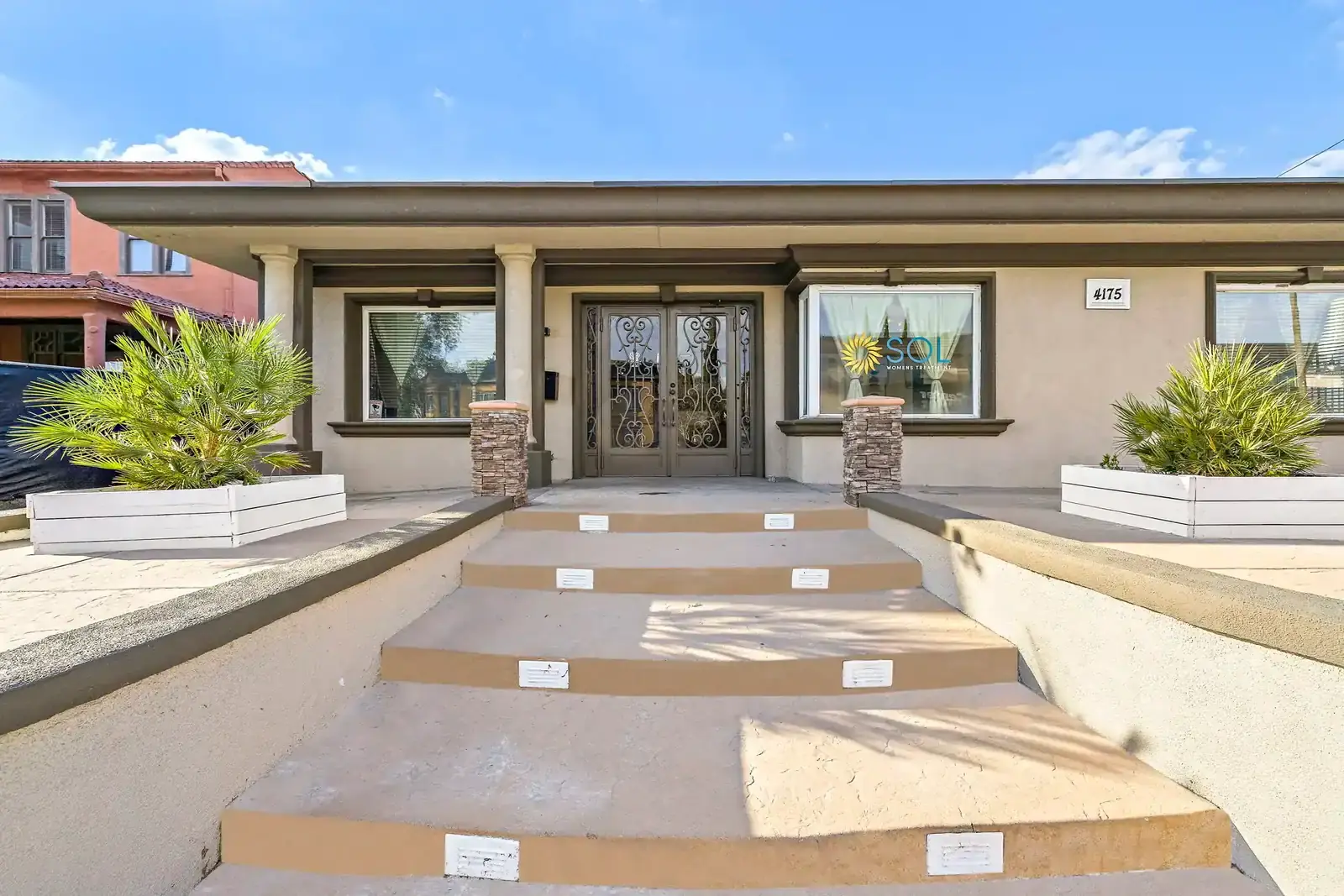
Sol is a licensed outpatient treatment center, not a wellness center or a spa. You cannot book a yoga class here on its own. Everything here happens in person at 4175 Brockton Avenue in Riverside. Sol does not offer telehealth or online sessions.
The weekly schedule is the same across all five of Sol’s programs, so there is no separate timetable. Every woman at Sol gets the same week, and the program she is in shapes what happens inside it, mostly through her individual session.
Key Takeaways
- What it is: yoga, breathing practice, sound sessions, movement and the female wellness panel, run inside Sol’s outpatient program in Riverside.
- Who it is for: women already in treatment at Sol. These sessions are part of the day, not a separate service.
- What the evidence says: supportive rather than curative. Federal reviewers describe possible benefits for stress and mood, and say plainly that the research is not strong enough to call any of it a treatment for a diagnosis.
- What does the treating: cognitive behavioral therapy, EMDR, group therapy, acceptance and commitment therapy groups and the rest of the clinical week.
- Where: in person in Riverside. Sol does not offer telehealth or online sessions.
Show all 5 takeaways
What the Sessions Actually Are
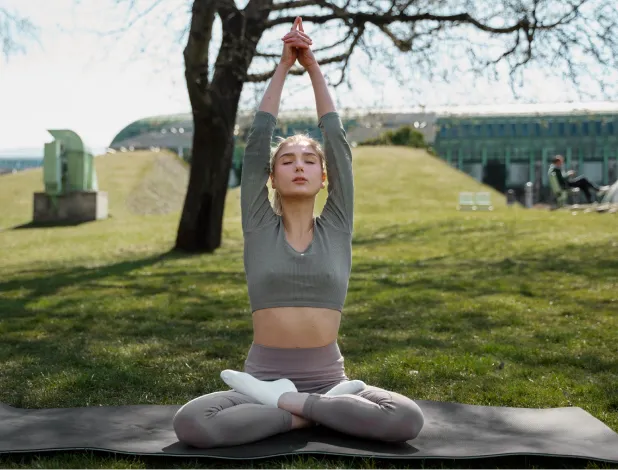
Yoga
Physical postures, breathing and stillness, taught in a room of women only. Mats and modifications provided. No experience assumed and nothing is compulsory.
Breathing practice
Slow, deliberate breathing, usually seated, usually short. The point is having something to do with your body when your mind will not slow down.
Sound sessions
You lie down and listen while instruments are played. Nothing is required of you. Most women describe it as rest.
Mindfulness meditation
Attention training, run as a group. This one has its own page: mindfulness and meditation therapy.
Movement
Two groups a week, run by Diana Saenz, NASM, who owns and operates her own female-focused gym in the area and comes to Sol to run them. Indoors, in the building, as part of the program day. Nothing competitive and no fitness level assumed.
Female wellness panel
A test that checks levels of key female wellness indicators, as part of your treatment week.
Movement, Twice a Week
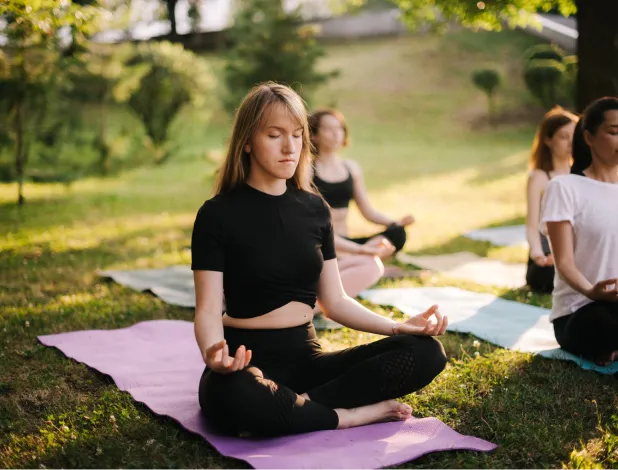
Twice a week, Diana Saenz, NASM comes to Sol and runs a movement group. She is a NASM-certified personal trainer and a certified health and wellness coach, with specialist certifications in women’s fitness and in perimenopausal and menopausal coaching, and she owns and operates her own female-focused gym in the area. The sessions happen indoors, in the building, inside the program day, so they are part of your week rather than something you arrange on your own.
Nobody is being trained for anything. There is no fitness level assumed, no competition in the room and no expectation that you keep up. You can sit part of it out.
The sessions are built around the connection between what is going on in your body and what is going on in your head, and they are in the week for a simple reason: treatment asks a lot of a woman’s attention and very little of her body, and a week made entirely of talking is harder to get through than a week that is not. Having somewhere to put restlessness, and half an hour that belongs to your body rather than your history, makes the rest of the day easier to sit in.
We keep our claim simple and careful: movement can make the rest of the day easier to sit with. It is not a replacement for medication, so if you take a prescription, please keep taking it and talk with your prescriber about any changes.
What the Research Actually Says

We want you to have an honest, careful picture of the research, so here is what it says.
Yoga. The National Center for Complementary and Integrative Health, the NIH center that reviews this research, uses the word “may”. On stress in healthy adults, a 2020 review of 12 studies found beneficial effects on perceived stress in all of them. On major depressive disorder, a 2020 review of 7 studies concluded yoga “may have small additional benefits for depression symptoms when used along with other forms of treatment.” On diagnosed anxiety disorders, a 2021 review’s authors “were unable to reach conclusions about whether yoga is helpful because not enough rigorous studies have been done.” And in a trial NCCIH funded itself, yoga for generalized anxiety disorder “improved symptoms but was less helpful than cognitive behavioral therapy, an established first-line treatment for this condition.”
The VA and Department of Defense 2023 clinical practice guideline for PTSD reaches the same place from the other direction. Its Recommendation 27 finds “insufficient evidence to recommend for or against” yoga, alongside relaxation training, somatic experiencing and the creative arts therapies. Not evidence against. Insufficient evidence.
Breathing practice. We found no federal evidence review of “breathwork” as a practice on its own. Breathing appears in the research as one component inside relaxation training, and NCCIH’s summary of relaxation techniques as a whole is that they “are generally safe, but there is limited evidence of usefulness for specific health conditions.” So we simply describe what it is and make no claim beyond that.
Sound sessions. We found no federal evidence review of sound baths. NCCIH has no topic page for sound healing or singing bowls, and its music and health page does not mention them. Music therapy research looks at something different, so we do not borrow it here. Many women find these sessions restful, and that is the only claim we make about them.
The frame that holds all three. NCCIH draws a line worth borrowing: an approach used together with conventional medicine is complementary, and one used in place of it is alternative. Everything on this page is the first kind. NCCIH’s own guidance is direct about it: “Do not use relaxation techniques as a replacement for conventional care.”
If a calming practice makes you feel worse, that is documented and it is not a failure on your part.
NCCIH states that “there have been rare reports that certain relaxation techniques might cause or worsen symptoms in people with epilepsy or certain psychiatric conditions, or with a history of abuse or trauma.”
Many women here carry trauma. Lying still with your eyes closed, or being asked to notice your breathing, can bring up more than it settles. Sometimes it brings up a great deal at once.
So, plainly:
- You can leave any session at any time and nobody will ask you why in front of the room.
- You can keep your eyes open, sit in a chair, stay near the door, or skip the session entirely.
- If a practice sets something off, tell your clinician. That is information about what is being treated, not a sign that you did it wrong.
On the physical side, NCCIH notes that yoga injuries are usually sprains and strains, that beginners should avoid extreme practices, and that some conditions call for modified poses. Tell the instructor about injuries, pregnancy, blood pressure, balance problems or anything else that affects how you move.
What This Is Not
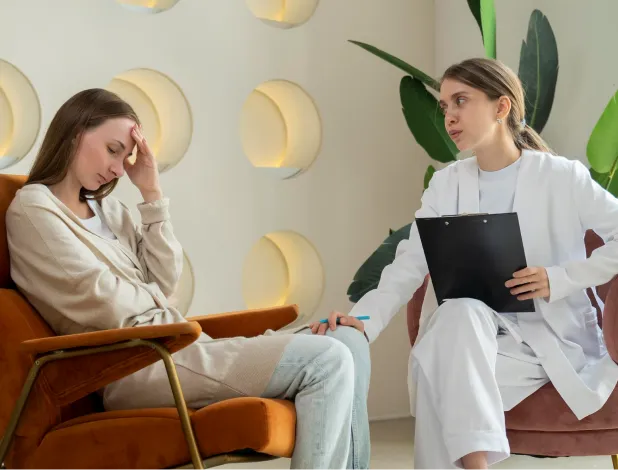
It is not treatment on its own. The clinical work at Sol is cognitive behavioral therapy, dialectical behavior therapy skills groups, acceptance and commitment therapy groups, EMDR, trauma therapy and group therapy. The wellness sessions support that week. They do not replace it, and nobody at Sol would suggest they could.
It is not a separate service you can book. There is no drop-in class, no day rate and no membership. These sessions are part of a treatment program, and a clinical assessment is where it begins.
It is not a spa. No massage, no facials, no treatments in that sense. If that is what you were hoping for, we want you to know now, gently, so you can find the right fit.
It is not a different week from the rest of Sol. All five of Sol’s programs run the same weekly schedule. The wellness sessions are in everyone’s week, and what makes a program a program is what happens inside that week, mostly in the individual session.
Levels of Care
The wellness sessions run across the program and the weekly schedule is the same in all five of Sol’s programs. Your assessment sets the level of care, which decides how many days a week you are here.
PHPPartial hospitalization
Roughly who it suits
The most structured daytime option, for when symptoms are at their heaviest.
Read more
IOPIntensive outpatient
Roughly who it suits
Fewer hours, more room for work and family, still substantial clinical contact.
Read more
OPOutpatient
How to Get Started
1
Call (951) 972-5085
Call (951) 972-5085 or verify your insurance, and our admissions team responds within 24 hours.
2
A Clinical Assessment
What has been happening, how long, what it is affecting.
3
A Level of Care and a Start Date
You will know both before you commit to anything.
Admissions answers 24 hours a day, 7 days a week.
Gentle Wellness Sessions, Woven Into Your Treatment Week
If treatment is what you need, talk to someone at Sol about where to start. Women only, outpatient, in Riverside.
4175 Brockton Avenue, Riverside, CA 92501
Frequently Asked Questions
Our admissions line is answered 24 hours a day, 7 days a week at (951) 972-5085.
Can I Book Just a Yoga Class at Sol?
No. Sol is a licensed outpatient treatment center, not a wellness center or a studio. Yoga, breathing practice and sound sessions run inside the treatment program as part of your week. There is no drop-in class and no membership.
Does Yoga Treat Anxiety or Depression?
Not on its own, and the research is careful here. NCCIH found that yoga “may have small additional benefits for depression symptoms when used along with other forms of treatment”, and on diagnosed anxiety disorders that reviewers “were unable to reach conclusions about whether yoga is helpful because not enough rigorous studies have been done.” In a trial NCCIH funded, yoga helped generalized anxiety but less than cognitive behavioral therapy did. Yoga can support your treatment, alongside the clinical work.
Is There Research on Sound Baths?
We found no federal evidence review of sound baths. NCCIH has no topic page on sound healing or singing bowls, and its music and health page does not mention them. Music therapy research looks at something different, so we do not borrow it here. Many women find these sessions restful, and that is the only claim we make about them.
What If Meditation or Lying Still Makes Me Feel Worse?
That happens, it is documented, and it is not a failure. NCCIH notes rare reports that relaxation techniques “might cause or worsen symptoms in people with epilepsy or certain psychiatric conditions, or with a history of abuse or trauma.” You can leave any session, keep your eyes open, sit in a chair or skip it. Tell your clinician afterwards, because it is useful information about what is being treated.
I Have Never Done Yoga and I Am Not Flexible. Is That a Problem?
No. No experience is assumed, modifications are offered, and nothing is compulsory. Tell the instructor about injuries, pregnancy, blood pressure or balance problems before you start.
What Is a Female Wellness Panel?
It is a test that checks levels of key female wellness indicators, as part of your treatment week. If you would like to know which specific markers it covers, just ask on your admissions call.
Is There Exercise, or Outdoor Activities?
There is movement, and it is indoors. Diana Saenz, NASM, who owns and operates her own female-focused gym in the area, comes to Sol twice a week and runs a movement group, in the building, inside the program day. There are no outdoor recovery activities at Sol, and we want you to know exactly what is on the schedule.
Can I Do Any of This Online?
No. Everything at Sol happens in person at 4175 Brockton Avenue in Riverside. There is no telehealth and no online option, for the wellness sessions or for anything else.
Is the Wellness Program a Different Weekly Schedule?
No. All five of Sol’s programs run the same weekly schedule, and the wellness sessions are in everyone’s week. What makes a program a program is what happens inside that week, mostly in your individual session.
Does Sol Accept My Insurance?
Sol accepts most major insurance plans, including Aetna, Anthem, Blue Cross Blue Shield, Carelon, CareFirst, Cigna, UC SHIP and UnitedHealthcare. Every plan is different, so the quickest way to know is to verify your insurance. Sol can often work with HMO policies through a single case agreement. Sol does not accept Medi-Cal, Medicaid, Medicare, Molina, IEHP, Kaiser, TRICARE or TriWest. Verify your insurance or call (951) 972-5085, and our admissions team responds within 24 hours.
Show all 10 questions
Medical Disclaimer
This page is for general information and is not a substitute for a clinical assessment, diagnosis or treatment by a qualified professional. The sessions described here run alongside clinical treatment and are not a treatment for any condition on their own. Sol is certified by the California Department of Health Care Services for outpatient and intensive outpatient services, certification 330246AP, and licensed by the California Department of Social Services, facility 331881576, and does not provide detox, inpatient or residential care. All services are delivered in person in Riverside, California. No two women respond identically and nothing here promises a result. If you are in crisis, call or text 988. If you are in immediate danger, call 911.
Sources5
- 1.National Center for Complementary and Integrative Health, Yoga: What You Need To Know. https://www.nccih.nih.gov/health/yoga-what-you-need-to-know
- 2.National Center for Complementary and Integrative Health, Relaxation Techniques: What You Need To Know. https://www.nccih.nih.gov/health/relaxation-techniques-what-you-need-to-know
- 3.National Center for Complementary and Integrative Health, 5 Things To Know About Relaxation Techniques for Stress. https://www.nccih.nih.gov/health/tips/things-to-know-about-relaxation-techniques-for-stress
- 4.National Center for Complementary and Integrative Health, Complementary, Alternative, or Integrative Health: What’s In a Name?. https://www.nccih.nih.gov/health/complementary-alternative-or-integrative-health-whats-in-a-name
- 5.VA and Department of Defense, Clinical Practice Guideline for the Management of Posttraumatic Stress Disorder and Acute Stress Disorder, 2023, Recommendation 27. https://www.healthquality.va.gov/HEALTHQUALITY/guidelines/MH/ptsd/VA-DoD-CPG-PTSD-Full-CPG-Edited-111624-V5-81825.pdf