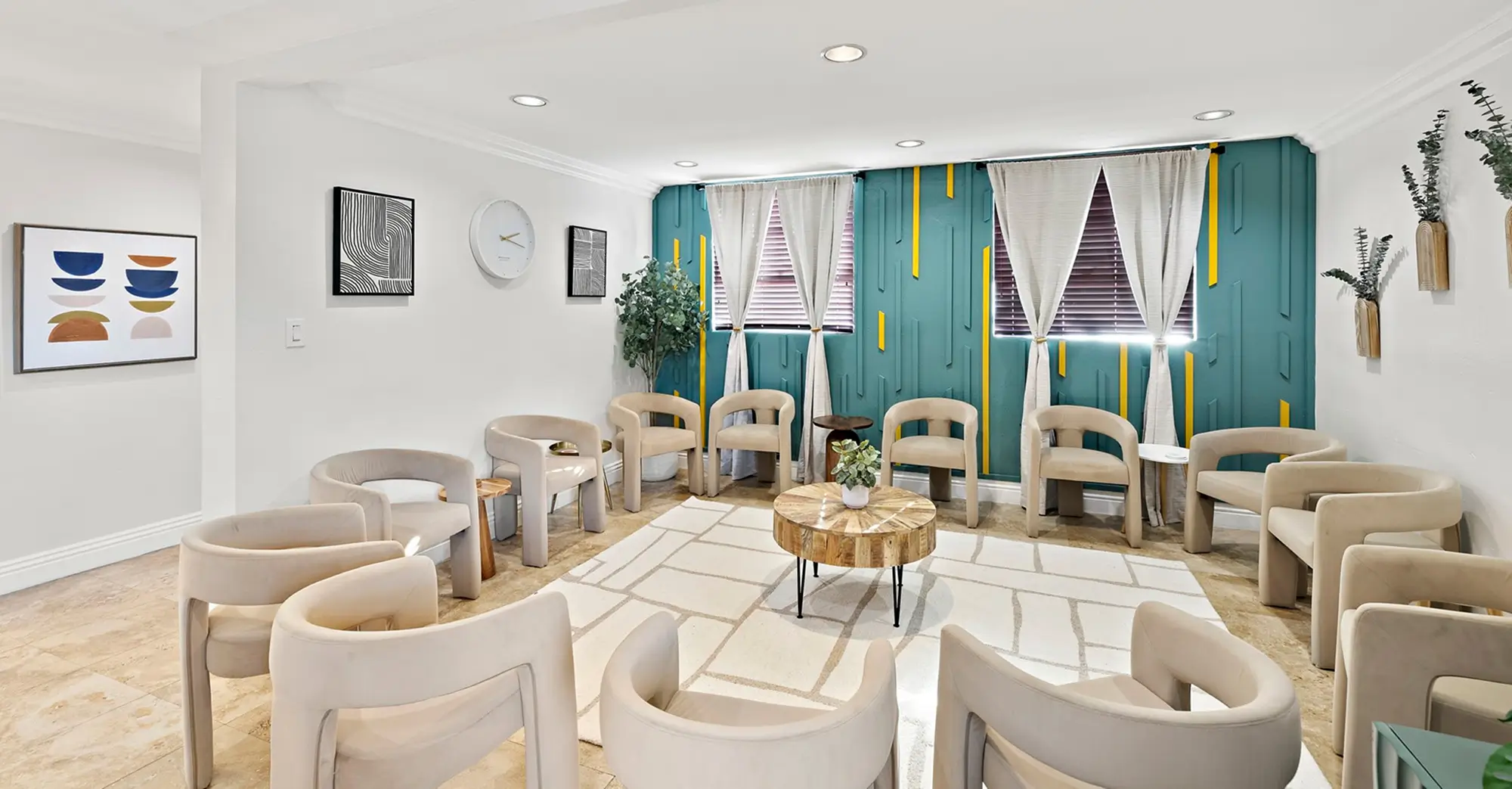
Trauma therapy for women is gentle, evidence-based care that helps you feel safe again, calm your body, and make sense of what happened, at your own pace. It is care shaped around women’s experiences, in a space that feels understanding rather than clinical. If you are in Riverside or anywhere across the Inland Empire, this guide walks you through what trauma therapy looks like, the approaches we use, and how to take a small first step whenever you feel ready.
Trauma therapy helps ease the emotional and physical weight that can linger after frightening or painful experiences. For women, that often means care built around gendered experiences like abuse, assault, or relationship harm.
At Sol, this care lives inside our trauma-targeted program for women, where safety, connection, and steady pacing come first. The goal is not to erase your past. It is to help you feel safe in your body and life again.
This approach follows trauma-informed principles described by the Substance Abuse and Mental Health Services Administration (SAMHSA), which center safety, trust, choice, collaboration, and empowerment. In practice, that means care that never pushes you faster than you are ready to go.
An all-female setting can lower the everyday cues that reactivate painful memories. It softens the fear of judgment and makes it easier to speak openly. For many women, that safety is what makes real healing achievable.
Gendered harms like sexual assault, domestic violence, and coercive relationships can leave layered, lasting effects. RAINN reports that about one in six women in the United States has experienced attempted or completed rape, which can raise the risk of post-traumatic stress and depression. Care that understands these patterns, including gaslighting and the cycle many survivors know as battered woman syndrome, tends to feel more validating.
Trauma care comes with its own vocabulary. Here are a few terms in plain language, so nothing feels confusing along the way.
There is no single right therapy for everyone. Your clinician helps you find the blend that fits your symptoms and comfort. Here is a gentle overview of approaches often used in women’s trauma care.
Leading evidence reviews, including guidance summarized by the National Institute for Health and Care Excellence, point to EMDR and trauma-focused CBT as well-supported options, often delivered in roughly eight to twelve sessions. Your plan may look different, and that is completely okay.
If you are wondering which approach might suit you, this can help you picture it. It is only a starting point, not a diagnosis. You and your clinician decide together, and the plan can change as you do.
Some weeks you may need more structure, and some less. Our outpatient levels of care let you receive steady support while you stay in your own home. If ever you need more than outpatient care can safely offer, we will help you find the right place.
When stable housing is part of feeling safe enough to heal, our supportive housing for women offers a calm place to stay within our outpatient program, with a female house manager available around the clock.
If your safety ever needs more than outpatient care can offer, a higher level of care, including inpatient care that Sol does not provide, may be the kindest next step. We will always help you find the right place and stay connected to your care.
Trauma often travels with other things, like anxiety, low mood, or substance use. When that happens, we care for everything together rather than in pieces. Treating co-occurring conditions at the same time tends to feel more supportive and whole.
If your trauma centers on post-traumatic stress, care focuses first on grounding and steadiness. Pregnancy and the months after birth deserve extra gentleness, so care during this time coordinates closely with your OB or midwife, with routine, non-judgmental check-ins about mood and safety.
Trauma can also follow a hard medical experience, like a difficult birth or a long hospital stay. Our team can coordinate with your doctors so that therapy and medical care support each other, and we can help women navigating postpartum depression alongside trauma.
The beginning is calm and unhurried. There is no pressure to share more than you want to. Here is what those early steps usually look like.
The calming skills you learn early on are simple and portable, things like slow breathing, grounding your senses in the present moment, movement, and naming what you feel. You are also always welcome to ask us questions, such as:
A little preparation can make that first conversation feel easier. None of this is required, so bring what you can and leave the rest.
You never have to share everything at once. Intake happens step by step, and your pace guides us.
Cost worries should never stand between you and care. You do not have to sort out coverage alone, and you never have to decide anything on the phone.
The easiest first step is to verify your insurance through our short, private form. A woman from our admissions team responds within 24 hours to explain what your plan may allow, with no pressure at all.
If you are in immediate danger, please call 911. For emotional support any time, call or text 988 to reach the Suicide and Crisis Lifeline.
The National Domestic Violence Hotline (1-800-799-7233) and RAINN (1-800-656-4673) are both free, confidential, and available around the clock. You deserve support, and reaching out is a brave first step.
Closer to home, Riverside County and San Bernardino County both have behavioral health access lines for same-day support and referrals, and local hospitals can connect you with a Sexual Assault Response Team or a victim advocate. If you are not sure who to call, your city’s non-emergency police line can point you to the right team.
Written by the Sol Women’s Treatment clinical team and reviewed by Tania Acevedo, MA, LPCC. Content is grounded in women’s mental health, trauma-informed care, and outpatient behavioral health practice. Updated regularly for clinical accuracy.
This article is for informational and educational purposes only and does not constitute medical advice, diagnosis, or treatment recommendations. If you or someone you know is experiencing a mental health crisis, please contact a qualified healthcare provider or call 988 (Suicide & Crisis Lifeline). Sol Women’s Treatment is a CDSS-licensed outpatient program, not inpatient or residential care. Individual results vary and no specific outcomes are guaranteed.
Choosing a mental health treatment center comes down to a few clear things: proper licensing, care built around women and trauma, evidence-based therapies, and an honest, no-pressure conversation about insurance. If you’re weighing your levels of care options, this guide is here to make the choice feel calmer, whether you’re looking for yourself or someone you love. You don’t have to have it all figured out before you reach out.
The right center is one where you feel safe, understood, and unhurried from the very first call. A few things make the biggest difference:
Most women’s mental health care happens at one of a few outpatient levels. The right one depends on how much structure and support feels right for where you are now.
Sol is an outpatient program with supportive housing, not a hospital or a residential facility. That means you receive structured, trauma-informed care during the day while keeping your own space and routine. If a woman’s needs ever call for a higher level of medical care, a good team will help her find the right place, gently and without judgment.
You don’t need a script or a clipboard. A few gentle questions will tell you most of what you need to know:
In California, mental health and addiction programs are overseen by state agencies, and a trustworthy program will tell you plainly how it’s licensed. Here’s how to check:
As an example of what that looks like: Sol Women’s Treatment is certified by the California Department of Health Care Services (DHCS) for outpatient and intensive outpatient services, and licensed by the California Department of Social Services (CDSS) as an Adult Day Program. You can read more about our care on our treatment center page.
Insurance can feel like the most stressful part, but it doesn’t have to be, and you don’t need all the answers before you reach out. A caring team will verify your benefits for you, confidentially, and explain what your plan covers in plain language. At Sol, we work with PPO and many HMO plans, and after you verify your insurance we’ll follow up, usually within one business day. Sol does not accept Medicaid or Medicare.
Most programs want to help. Still, a few things are worth paying gentle attention to as you compare your options:
Written by the Sol Women’s Treatment clinical team and reviewed by Tania Acevedo, MA, LPCC. Content is grounded in women’s mental health, trauma-informed care, and outpatient behavioral health practice. Updated regularly for clinical accuracy.
This article is for informational and educational purposes only and does not constitute medical advice, diagnosis, or treatment recommendations. If you or someone you know is experiencing a mental health crisis, please contact a qualified healthcare provider or call 988 (Suicide & Crisis Lifeline). Sol Women’s Treatment is a CDSS-licensed outpatient program, not inpatient or residential care. Individual results vary and no specific outcomes are guaranteed.
Being the first in your family to attend college is a quiet kind of brave. There’s pride. There’s pressure. And often, there’s no one in your immediate world who’s done this before — no one who can decode the FAFSA, explain what office hours really mean, or talk you through what to do when a syllabus stops making sense.
That gap matters. Continuing-generation students often have a parent or sibling who’s walked the same path. First-gen students are building the map and walking it at the same time.
Research from groups like the Center for First-Generation Student Success and the American Council on Education consistently shows that first-generation college students experience higher rates of anxiety, depression, and stress-related health concerns than their continuing-generation peers. The reasons are layered:
Anxiety doesn’t always look like panic. For many first-gen women, it shows up in patterns that look productive on the outside but feel exhausting on the inside. A version of high-functioning anxiety — where you’re showing up, getting things done, hitting the GPA, but the volume inside is unbearable. Some of what that can look like:
Depression in college often doesn’t look like the textbook version. You might not feel sad. You might feel flat, foggy, or quietly numb. Some signs to know:
If you’ve been telling yourself “I’m just tired,” but the tired isn’t going away, that’s worth taking seriously. Emotional numbness often masks depression in women — especially women who’ve spent years holding things together for everyone else.
First-gen women often carry layers their male peers and continuing-generation peers don’t. You might be:
That’s a lot. And it’s often invisible to the people around you — even to counselors and friends who haven’t lived it.
UC Riverside has one of the highest percentages of first-generation students in the UC system. If you’re a first-gen woman at UCR, you’re not the exception — you’re part of a large community of women navigating the same pressures, often quietly.
The same is true at other schools nearby. California Baptist University, La Sierra University, Riverside City College, Norco College, and Moreno Valley College all serve large first-gen populations. Students at Cal State San Bernardino, just a short drive away, share many of the same realities.
Campus counseling centers across these schools do meaningful work, but most have session limits per academic year and long wait times during peak weeks. That’s not a knock on those centers — they’re stretched thin because the need is real. It just means many women need support that goes deeper or lasts longer than a campus office can offer.
Sol’s Student Support Program was built for exactly this — women in school who need consistent, women-only mental health care that fits around classes.
There isn’t one right path. Different women need different combinations of support, and what works in one semester may shift in the next. A few approaches that tend to help first-gen women specifically.
You’re not alone in this. Many UCR first-gen women have found relief in groups — both clinical and informal — where they can speak openly about pressure, identity, and family without having to translate their experience. Group therapy at Sol is women-only and designed to feel safe before it asks anything of you.
When campus support isn’t enough, outpatient treatment offers deeper care without pulling you out of school. Sol Women’s Treatment offers women-only outpatient programs in Riverside that can be scheduled around classes — from more intensive PHP, to step-down IOP, to weekly OP.
You don’t have to wait until you’re in crisis to ask for help. Some quiet signs it might be time to seek support:
If you’re in immediate crisis, call or text 988 — the Suicide & Crisis Lifeline. You’re worth that call.
Sol Women’s Treatment is an all-female, outpatient program in Riverside, California — built for women navigating mental health, addiction, and trauma, including the layered pressures first-gen students carry. With a maximum of 25 clients at a time, every woman gets attention, not a number.
What that looks like in practice:
Written by the Sol Women’s Treatment clinical team and reviewed by Tania Acevedo, MA, LPCC. Content is grounded in women’s mental health, trauma-informed care, and outpatient behavioral health practice. Updated regularly for clinical accuracy.
This article is for informational and educational purposes only and does not constitute medical advice, diagnosis, or treatment recommendations. If you or someone you know is experiencing a mental health crisis, please contact a qualified healthcare provider or call 988 (Suicide & Crisis Lifeline). Sol Women’s Treatment is a CDSS-licensed outpatient program — not inpatient or residential care. Individual results vary and no specific outcomes are guaranteed.
Commuting to UC Riverside or another Riverside-area campus can quietly chip away at your mental health. The long drives, the parking scramble, the rushed mornings, the late-night returns — it adds up. If your commute has started to feel like it’s costing you more than time, you’re not imagining it. Our off-campus support for women attending UC Riverside was built for exactly this — students juggling long drives, full schedules, and the emotional weight that comes with both.
Commuter stress is the cumulative emotional, physical, and mental strain that builds when getting to and from campus becomes a daily friction point. It’s not a single bad day — it’s a pattern. And for college students, that pattern often shows up as eaten-up study time, missed sleep, distance from on-campus life, and a quiet sense that the day already started before it began.
It’s different from typical school stress because the commute itself becomes a stressor. You’re tired before class. You’re rushing after class. You’re navigating traffic when your brain still needs to process what you just learned. If work or family lives off-campus too, the friction doesn’t fully reset on weekends.
Many students don’t name it as a mental health concern. They just call it “tired” or “stressed.” But over weeks and months, the toll is real — and worth taking seriously.
UC Riverside has reported that more than 14,000 students commute daily — a number that shapes the entire campus experience. The 91 and 60 freeways can turn a 20-mile drive into a 90-minute crawl. Parking competition is intense, and the loop of arriving early just to find a spot adds friction before class even starts.
Many students drive in from Moreno Valley, Corona, Fontana, Rancho Cucamonga, San Bernardino, and farther. A round trip can easily reach two hours on a heavy day. Across a five-day school week, that’s ten hours — a full workday — quietly absorbed by the commute alone.
The IE traffic patterns are part of it. So is the cost-of-living math that pushes many students to live with family rather than near campus. It’s not a failure of effort; it’s the daily reality of attending college in a region this large. For a wider look at the UCR-specific picture, our broader UCR off-campus mental health resources walk through how this all fits together.
Research has consistently linked long commutes to higher rates of anxiety, depression, sleep loss, and burnout. The mechanisms are layered — chronic low-grade stress activation, lost personal time, social isolation, and less room for the basics that protect mental health (sleep, movement, cooking, real connection).
For students, the toll often shows up as:
If several of these have crept in over the past few months, it may be a sign your mental health needs more support.
Not every hard week is a crisis. But there’s a difference between a tough Tuesday and a pattern. The pattern signals are the ones worth paying attention to.
Watch for:
These can be early signs of high-functioning anxiety, burnout, or depression — and all three are treatable.
Women navigating a long college commute often carry layers their male peers don’t.
Safety is one. Late drives, dim parking structures, public transit at night — the constant low-grade vigilance is its own mental load.
Caregiving is another. Many women drive home to family responsibilities — younger siblings, kids, aging parents — and the day doesn’t end when the car parks. That second shift eats into recovery time that others may protect more easily.
Hormonal patterns matter too. Sleep deprivation interacts with menstrual cycles, postpartum recovery, and stress hormones in ways that can amplify anxiety and low mood. Some weeks the same commute feels manageable. Other weeks, the body is already running on less.
Our Women’s Wellness Program was built with these layers in mind. The all-female environment lets women set down the constant vigilance — even briefly — and the small-census setting (maximum 25 clients at a time) keeps the experience personal.
Small changes compound. None of these replace professional support for clinical anxiety or depression, but most students feel meaningful relief from layering several of them together.
If you’re already trying most of the above and still feel like you’re running on fumes, that’s worth listening to. For some women, working with a clinician on mindfulness-based therapy is the missing piece — especially when the feeling has shifted from “stressed” to chronic overwhelm.
There’s a point where strategies aren’t enough — and reaching for support isn’t a failure. It’s a smart, protective move.
Consider talking to a professional if:
Outpatient mental health care is designed to fit alongside school and a commute — not interrupt them. You don’t have to leave UCR or your job to get real support.
Sol is an all-female outpatient program in Riverside, just minutes from UCR. We were built specifically for women navigating mental health, trauma, and stress-driven concerns — with a maximum of 25 clients at a time, so no one becomes a number.
Our Student Support Program weaves in the realities of academic life — class schedules, commute windows, exam weeks — instead of fighting them. Care is structured in levels you can scale to your life:
You don’t have to have it all figured out before reaching out. The first call is short, gentle, and built around what you’re already dealing with.
Written by the Sol Women’s Treatment clinical team and reviewed by Tania Acevedo, MA, LPCC. Content is grounded in women’s mental health, trauma-informed care, and outpatient behavioral health practice. Updated regularly for clinical accuracy.
This article is for informational and educational purposes only and does not constitute medical advice, diagnosis, or treatment recommendations. If you or someone you know is experiencing a mental health crisis, please contact a qualified healthcare provider or call 988 (Suicide & Crisis Lifeline). Sol Women’s Treatment is a CDSS-licensed outpatient program — not inpatient or residential care. Individual results vary and no specific outcomes are guaranteed.
Academic burnout in college women is a deep state of emotional, mental, and physical exhaustion brought on by sustained academic pressure — and it rarely arrives alone. For many women, burnout shows up tangled with anxiety, low mood, perfectionism, and a quiet sense of disconnection from school, friends, and yourself. If you’ve been pushing through papers and exams while feeling more drained, more reactive, or more numb than usual, your body is asking for something different. Sol Women’s Student Support Program is built for moments like this — calm, women-only outpatient care that meets you where you are.
Burnout has a specific shape. It’s not the same as a hard week, a tough finals stretch, or feeling tired after a long semester. It’s a sustained state of depletion — emotional, mental, and physical — that doesn’t ease with a weekend off. Researchers describe burnout in three dimensions: deep emotional exhaustion, growing cynicism or detachment from your work, and a fading sense that what you’re doing matters or that you’re doing it well.
For college women, burnout often gets shaped by self-criticism. The voice in your head stops sounding like a coach and starts sounding like a critic. You’re falling behind. You should be able to handle this. Everyone else is fine. That voice is part of the pattern.
Some of the most common ways burnout shows up:
Many women carry burnout alongside high-functioning anxiety — looking composed on the outside while running on empty inside.
Burnout isn’t gendered in its biology, but it’s shaped by gendered expectations and pressures. College women often experience burnout through a different filter than their male peers — and the patterns are worth naming.
These three states overlap, especially in college women, but each has a distinct shape. Recognizing which is dominant — or whether all three are present — helps point you toward the right kind of support.
Anxiety can fuel burnout, and burnout can tip into depression if it goes unaddressed for long enough. Many women experience all three at once. Understanding the layers helps you and a therapist get specific about what’s happening — and what kind of support might help.
Most academic burnout doesn’t have one cause. It’s a slow accumulation — and certain pressure points show up across stories. Knowing yours can help you spot the pattern earlier next time.
Burnout doesn’t stay in your head. It moves through your body — and women often notice physical symptoms before they notice the emotional pattern underneath.
When the body is loud, that’s worth listening to — not as a problem to silence, but as information.
Self-care doesn’t fix burnout, but it can lower the daily intensity and create space for deeper healing. Some shifts that genuinely help:
If self-care isn’t moving the needle, our guide on signs it’s time to seek mental health support as a woman walks through what comes next — and our piece on dealing with overwhelm offers more grounded next steps.
There’s no formula for when to ask for help, but there are signals that almost always point in that direction.
Outpatient mental health care can fit alongside school. Sol’s Intensive Outpatient Program (IOP) and outpatient track are designed to support recovery while you stay enrolled.
Sol Women’s Treatment is a CDSS-licensed outpatient program in Riverside, CA, built specifically for women — including students navigating the exact pressures described above. The environment is small, gender-specific, and grounded in trauma-informed care.
A few things that make Sol different:
Women attending UC Riverside can also explore our off-campus treatment options for UCR students.
Written by the Sol Women’s Treatment clinical team and reviewed by Tania Acevedo, MA, LPCC. Content is grounded in women’s mental health, trauma-informed care, and outpatient behavioral health practice. Updated regularly for clinical accuracy.
This article is for informational and educational purposes only and does not constitute medical advice, diagnosis, or treatment recommendations. If you or someone you know is experiencing a mental health crisis, please contact a qualified healthcare provider or call 988 (Suicide & Crisis Lifeline). Sol Women’s Treatment is a CDSS-licensed outpatient program — not inpatient or residential care. Individual results vary and no specific outcomes are guaranteed.
Campus counseling helps a lot of women through a hard semester — and for some, it really is enough. But if you’ve been showing up to sessions and still feel stuck, overwhelmed, or unsafe inside your own mind, your care may need to grow with you. Off-campus mental health treatment for students near UC Riverside is built for that moment — when weekly support isn’t quite holding the weight you’re carrying.
Campus counseling is often the first warm room a woman walks into when something inside starts to feel heavy. It’s right there on campus, included in tuition or covered through student health, and gentle enough to step into without making a big decision first. For a lot of students, it’s enough — especially when the issue is adjustment stress, a rough breakup, exam-season overwhelm, or a hard but ordinary patch of life. When it isn’t, learning how to choose the right treatment center is the more useful next question.
A good campus counselor can help you put words to what you’re feeling, build coping skills, and steady your week. The relationship matters. If your campus counselor has helped you feel less alone, that work counts — and it’s worth holding onto, even if you decide later that you need more.
The clearest sign is the one that keeps quietly waving at you — your symptoms aren’t easing, even though you’re doing the work. The list below isn’t a checklist to qualify yourself with. It’s a gentle mirror.
Campus counselors are skilled, caring clinicians — but the system around them has structural limits. Knowing what those limits are makes it easier to see when you’ve outgrown the support you have access to.
Sometimes weekly therapy is the right rhythm — and sometimes it leaves too much space between you and the support you need. Our deeper guide on signs a college student may need more than weekly therapy walks through this in detail. The simplest version is this — if your week feels like a survival project between sessions, you probably need more than a once-a-week appointment.
That’s where structured outpatient care comes in. Levels of care exist for a reason. They meet you at the intensity you actually need, instead of asking you to fit into a single rhythm.
You don’t have to choose between school and getting better. Outpatient care is built around real life — IOP usually runs in mornings or evenings, OP sessions are scheduled around classes, and many women keep working part-time or stay enrolled full-time while in treatment. Sol’s Student Support Program is structured specifically for college students juggling academic load and recovery at the same time.
For students who need more stability than a dorm or apartment provides — quieter nights, fewer triggers, more support between sessions — supportive housing offers a calm, all-female living environment with 24/7 house manager support. It’s not residential treatment. It’s a place to live well while doing the deeper work of recovery.
If you’re a UCR student, you have specific options nearby. Sol Women’s Treatment is in Riverside, minutes from campus, and built specifically for women — including students. We’ve put together additional resources in our overview of mental health support for UCR students in Riverside, plus a fuller guide to off-campus treatment options for women attending UC Riverside.
The short version — you don’t have to leave the area, you don’t have to leave school, and you don’t have to figure this out alone.
Bringing it up can feel awkward, but most campus counselors welcome the conversation. They know the limits of their setting, and they often have relationships with outside providers. Here’s a gentle way to walk through it:
You don’t need a perfect reason or a worst-case scenario. The honest version — if you’ve been wondering whether you need more help, that wondering counts. It’s the kind of quiet, persistent signal that’s usually right.
A few softer questions to sit with:
A “yes” to any of these is enough. You don’t have to be in crisis to deserve more care.
Written by the Sol Women's Treatment clinical team and reviewed by Tania Acevedo, MA, LPCC. Content is grounded in women's mental health, trauma-informed care, and outpatient behavioral health practice. Updated regularly for clinical accuracy.
This article is for informational and educational purposes only and does not constitute medical advice, diagnosis, or treatment recommendations. If you or someone you know is experiencing a mental health crisis, please contact a qualified healthcare provider or call 988 (Suicide & Crisis Lifeline). Sol Women's Treatment is a CDSS-licensed outpatient program — not inpatient or residential care. Individual results vary and no specific outcomes are guaranteed.
The clearest signs a college student needs more than weekly therapy are persistent functional decline despite consistent sessions, escalating substance use, repeated returns to crisis, and active suicidal thoughts that aren’t easing. When these patterns show up week after week, a higher level of care like Intensive Outpatient (IOP) or Partial Hospitalization (PHP) can hold the next layer of work without forcing a student to step away from school.
Here at Sol Women’s Treatment, our Student Support Program is built for college-age women navigating that step up, with trauma-informed care, small groups, and scheduling that can flex around classes.
Catching a slide early protects safety, academic progress, and the trust you’ve built with the people supporting you. The University of Michigan’s Healthy Minds Study found that during the 2021–22 academic year, 44% of college students reported symptoms of depression, 37% reported anxiety, and 15% reported having seriously considered suicide in the past year, the highest rates in the survey’s 15-year history. That doesn’t mean every student needs more care. It does mean the safety net needs to be more responsive when symptoms move.
Stepping up doesn’t mean dropping everything. It means adding layers. More clinical contact, more structured groups, sometimes medication management, so you can stay steady while you work through what’s underneath.
College students rarely fit a single profile when weekly therapy starts to fall short. Patterns tend to show up across three areas: academics, behavior, and safety. The student who looks fine in session but is unraveling between appointments is one of the most common (and easiest to miss). Sustained academic burnout often shows up earlier in that picture than crisis-level symptoms do — and for college women in particular, it can be the cue that weekly sessions need to layer up.
If you or someone you love is in immediate danger, call 988 or 911. After safety stabilizes, a higher level of care can hold the next layer of work.
The student most likely to benefit from a step up before crisis is the one still attending class, still turning in assignments, but quietly losing access to themselves. Watch for:
If that’s the picture, it doesn’t have to wait for crisis to count.
Levels of care sit on a continuum that increases in time, intensity, and supervision. The right level depends on how much structure your safety and stability need right now.
The 9 to 19 hour range for adult IOP reflects SAMHSA’s clinical guidance, with the higher end reserved for higher acuity. When students are appropriately matched, outpatient intensive treatment can produce outcomes comparable to inpatient care at significantly lower cost. Sol Women’s Treatment is a CDSS-licensed outpatient program. Our women’s Intensive Outpatient Program sits within this continuum, and we coordinate referrals to inpatient or residential care when safety calls for it.
For a side-by-side breakdown of how IOP and PHP differ in hours, structure, and clinical fit, our PHP vs. IOP guide walks through the differences in detail.
Most students stay enrolled during IOP. Some PHP students continue with reduced course loads or take a short medical leave. The path depends on the program’s hours, your school’s accommodations process, and how much energy you have to give to coursework while in active treatment. Our Partial Hospitalization Program runs as a daytime program and is often the right step when symptoms need closer clinical oversight than IOP can offer.
A few practical steps to start the conversation with school:
If you’re a student in Riverside or attending UC Riverside, our off-campus student mental health support is built around this exact balance. School stays on the table while real treatment happens off campus.
Coming back to a full course load after IOP or PHP works best when the return is staged. Talk with your advisor about a lighter first semester back. Plan one consistent appointment with campus counseling. Keep at least one of the supports that worked for you during treatment, whether that’s a weekly group, a medication check-in, or a peer recovery contact. The goal is steady ground, not a sprint. Our off-campus treatment options for women attending UC Riverside blog walks through how local students have managed that handoff.
Stepping up isn’t about giving up on weekly therapy. It’s about meeting current needs with the right amount of structure. Stepping down is about easing back as stability returns. Both decisions are best made with your treating clinician, not in isolation. If you do decide to step up, our guide to choosing a women’s mental health treatment center can help you compare programs.
Common reasons to step up:
Common reasons to step down:
Reassessment cadence varies by program and clinician. Intensive outpatient guidance describes ongoing clinical monitoring with regular formal reviews, often monthly during steady-state IOP and more frequently during transitions. The exact rhythm should be set by your clinical team based on your response to treatment.
When mental health and substance use overlap (depression and alcohol, trauma and disordered eating, anxiety and stimulant use), symptoms tend to compound. Weekly therapy alone often can’t hold all of it. The National Institute on Drug Abuse recommends treating co-occurring disorders concurrently rather than sequentially, which usually means more intensive, integrated care.
Sol’s trauma-targeted program integrates EMDR, DBT skills, somatic work, and case management for women whose symptoms are layered together. The way symptoms compound is often the reason weekly therapy isn’t enough, and integrated care for co-occurring conditions tends to land better than treating each issue in isolation.
Naming what’s happening out loud is sometimes the hardest part. A simple template helps:
With your therapist: “I’m still struggling despite weekly sessions. I’d like to talk about whether IOP or PHP might be a better fit right now.” Ask if they can complete referral forms, write documentation for school, and coordinate with the intake team at the program you’re considering.
With campus counseling: Tell them where you are and ask which higher-intensity options they recommend or refer to. Ask about expected wait times and what documentation they can provide for accommodations.
With family or a support person: Be specific about what you need. Examples: “Sit with me while I make these calls.” “Help me track what each program said.” “Drive me to my first intake.” A small, concrete ask is easier to receive than a general one.
Cost is often what stalls the step up. It doesn’t have to. A quick benefits check usually clarifies what’s covered before any commitment is made.
A few things worth knowing:
Bring your insurance card, current medication list, and any clinician letters when you schedule your assessment.
A women-only setting changes what feels possible to say in group. For students carrying trauma, relationship harm, postpartum experiences, or substance use that started as coping, that environment matters. Sol Women’s Treatment caps its census at 25 clients across all levels of care, so groups stay small and trust builds faster.
What that looks like in practice:
Treatment is led by Tania Acevedo, MA, LPCC, Sol’s founder and Chief Clinical Officer, alongside a team of clinicians who specialize in women’s mental health, trauma, and addiction recovery.
If you’d like to talk through whether IOP, PHP, or another level of care fits your situation, our admissions team is here. Call us at (951) 633-7724 when you’re ready.
Reaching out doesn’t mean you’ve made up your mind. A short conversation can help you figure out whether IOP, PHP, or another level of care is the right next step for you or someone you love. There’s no pressure to decide on the call.
When you’re ready, our admissions team is happy to walk you through your options at the pace that feels right. Call us at (951) 633-7724, or check your coverage in a few minutes through our verify insurance form. Whatever the next step looks like, you don’t have to figure it out alone.
Written by the Sol Women’s Treatment clinical team and reviewed by Tania Acevedo, MA, LPCC. Content is grounded in women’s mental health, trauma-informed care, and outpatient behavioral health practice. Updated regularly for clinical accuracy.
This article is for informational and educational purposes only and does not constitute medical advice, diagnosis, or treatment recommendations. If you or someone you know is experiencing a mental health crisis, please contact a qualified healthcare provider or call 988 (Suicide & Crisis Lifeline). Sol Women’s Treatment is a CDSS-licensed outpatient program — not inpatient or residential care. Individual results vary and no specific outcomes are guaranteed.
A mental health leave of absence is a formal, school-approved pause from college that lets you step away from classes — usually for one or two semesters — to focus on treatment and recovery. You request it through your school’s dean of students, registrar, or counseling office, document the medical reason with a licensed clinician, and use that protected time to stabilize before coming back. For women carrying anxiety, depression, trauma, or burnout that’s outgrown weekly therapy, the leave is often the difference between barely holding on and actually getting better. Sol’s Student Support Program is built around this exact moment — outpatient care designed to help you heal during your leave so you return steadier than when you left.
A mental health leave of absence — sometimes called a medical leave or wellness leave — is a temporary, school-approved pause from college for mental health reasons. You stay enrolled at the school, but you stop attending classes for a defined period and focus your energy on getting well.
It’s different from a regular withdrawal. A withdrawal usually drops you out of the school entirely, and you’d have to reapply if you wanted to come back. A leave of absence keeps your enrollment, your major, your academic standing, and often your housing eligibility intact. When the leave ends, you return — sometimes with conditions like a clinician’s clearance letter or a check-in with the dean — and pick up where you left off.
The reasons women take a mental health leave are wide. Some are managing anxiety, depression, or panic that’s making class impossible. Some are working through trauma that resurfaced. Some are in early recovery from substances and need real treatment, not the chaos of a college schedule. Some are postpartum, navigating relationship stress, or running on fumes after months of trying to push through. Whatever the reason, the leave isn’t a failure. It’s a clinical decision that lets you actually get well.
There’s no checklist that says it’s time to step away. But there are patterns worth paying attention to. If you’ve been wondering whether weekly therapy is still enough, that’s a real signal worth listening to.
Any one of these can be enough. Several together, especially if campus counseling isn’t enough anymore, is a sign your current setup isn’t working — and that’s worth taking seriously, not pushing through.
Every college runs its own process, but most follow the same five-step path. Walking through it with a clinician on your side makes the practical pieces much easier.
Schools want to confirm the leave is medically necessary, not just a difficult semester. Here’s what most colleges ask for:
This is the part that catches most students off guard. A leave of absence triggers a chain of practical changes — some are easy to manage, some need a few phone calls. Walk through each before you submit your request.
The return is where a lot of leaves quietly fall apart. Coming back without a plan tends to land you back in the same patterns that led to the leave in the first place. Coming back with structure tends to mean you actually stay.
Sol is a CDSS-licensed outpatient program in Riverside, California, built specifically for women. We work with college students taking a mental health leave through our Student Support Program and our off-campus student mental health program — including women on leave from UC Riverside and other California colleges. The program is intentionally small (no more than 25 women at a time), all-female, and designed around what college-age women actually need: trauma-informed care, modality depth, and a real clinical structure that doesn’t try to push you back into the world before you’re ready.
If campus counseling has run its course or UCR’s mental health resources aren’t enough on their own, a structured outpatient leave is often the next right step. Reach out and we’ll walk you through what your insurance covers and what care could look like for you.
Written by the Sol Women’s Treatment clinical team and reviewed by Tania Acevedo, MA, LPCC. Content is grounded in women’s mental health, trauma-informed care, and outpatient behavioral health practice. Updated regularly for clinical accuracy.
This article is for informational and educational purposes only and does not constitute medical advice, diagnosis, or treatment recommendations. If you or someone you know is experiencing a mental health crisis, please contact a qualified healthcare provider or call 988 (Suicide & Crisis Lifeline). Sol Women’s Treatment is a CDSS-licensed outpatient program — not inpatient or residential care. Individual results vary and no specific outcomes are guaranteed.
If you’re a woman at UC Riverside and you’ve been quietly struggling — with anxiety, depression, trauma, burnout, or something you haven’t quite named yet — you’re not imagining it, and you’re not alone. UCR’s on-campus counseling services are a real and accessible starting point. But for many students, especially those managing more complex mental health needs, campus support has limits. When it isn’t enough, outpatient mental health programs in Riverside offer a next step — one that works around your schedule and stays grounded in your real life.
UCR’s Student Health and Counseling Center (SHCS) provides individual counseling, group therapy, crisis support, and psychiatric referrals. For many students, it’s a lifeline — especially for those who are navigating mental health support for the first time.
Where campus services tend to have limits:
None of this means campus counseling isn’t worth using. It absolutely is. But it’s a starting point, not a ceiling.
It’s easy to talk yourself out of seeking additional help. You’re a student. Everyone is stressed. You don’t want to make a big deal of it. But some experiences go beyond ordinary academic stress — and recognizing the difference matters. For UCR students balancing long drives with packed schedules, the chronic commuter stress that builds across a semester is often one of those experiences — easy to normalize, harder to outrun.
You may benefit from a higher level of care if you’re:
These experiences are more common among women in college than most people realize. If any of this feels familiar, it might be worth exploring women’s mental health programs that go deeper than a weekly 50-minute session.
Outpatient mental health treatment is not what many people picture when they hear “treatment.” It’s not inpatient. It’s not a leave of absence from school. It’s structured, evidence-based care that fits around your life.
There are three primary outpatient levels of care:
Sol Women’s Treatment offers all three levels of care — PHP, IOP, and OP — in an all-female environment in Riverside, minutes from the UCR campus.
Sol’s Student Support Program was built with the reality of student life in mind. College isn’t just a schedule — it’s a particular kind of pressure, identity, and transition. The program integrates treatment with the stressors that are specific to women navigating academic demands, social dynamics, financial stress, and questions about what comes next.
What makes this program distinct:
Students reach out to Sol for a range of mental health concerns. Some arrive with a formal diagnosis. Others come in knowing only that they’re not okay and that campus resources weren’t enough.
Conditions frequently addressed include:
Sol also works extensively with women navigating high-functioning anxiety, emotional numbness, burnout, and feelings of overwhelm — experiences that are common in college and often go unaddressed until they become more serious.
Sol’s clinical team draws from an intentionally broad modality menu. The goal is to match treatment to each woman’s needs — not to fit her into one approach.
Therapy modalities offered include:
Sol Women’s Treatment accepts UC SHIP — the University of California’s student health insurance plan, which most UCR students carry. For many students, this is how treatment becomes genuinely accessible. Sol also accepts Aetna, Anthem, BCBS, Cigna, Carelon, CareFirst, and UHC.The best way to confirm exactly what your plan covers is to use the free insurance verification form. The admissions team will review your specific benefits and walk you through your options — clearly, and with no pressure.
For students who need more stability than home or campus housing provides during treatment, Sol also offers supportive housing — a sober, all-female living environment in Riverside with 24/7 house manager support. This option allows students to fully focus on recovery without the disruptions of a less structured living situation, and pairs well with PHP or IOP.
You don’t need to hit a crisis point before you deserve support. The following are all valid reasons to reach out to Sol or explore an admissions conversation:
Asking for more help is not an overreaction. If you’re reading this and something is resonating, that’s probably worth paying attention to. The admissions team at Sol is easy to talk to — and a conversation doesn’t commit you to anything.
Written by the Sol Women’s Treatment clinical team and reviewed by Tania Acevedo, MA, LPCC. Content is grounded in women’s mental health, trauma-informed care, and outpatient behavioral health practice. Updated regularly for clinical accuracy.
This article is for informational and educational purposes only and does not constitute medical advice, diagnosis, or treatment recommendations. If you or someone you know is experiencing a mental health crisis, please contact a qualified healthcare provider or call 988 (Suicide & Crisis Lifeline). Sol Women’s Treatment is a CDSS-licensed outpatient program — not inpatient or residential care. Individual results vary and no specific outcomes are guaranteed.
Campus support is a wonderful starting point — but sometimes healing calls for something deeper. If you’re a woman at UC Riverside navigating anxiety, depression, trauma, substance use, or a mix of challenges that feel too heavy for a weekly therapy appointment, structured off-campus treatment in Riverside may be exactly the next step your recovery needs.
 Key Takeaways
UC Riverside’s Counseling and Psychological Services, known as CAPS, is the go-to resource for many students. It’s free, confidential, and located right on campus. CAPS offers individual therapy, group counseling, crisis support, and psychiatric referrals — genuinely valuable resources, especially for students encountering mental health challenges for the first time.
That said, campus counseling centers are designed for short-term support. If your situation involves more ongoing needs — chronic anxiety, trauma history, substance use, or symptoms that make it hard to get through a normal day — you may find that weekly sessions don’t go far enough.
A few things to know about CAPS:
None of this means CAPS isn’t valuable — it absolutely is. It means that if you’ve been going to therapy and still feel like you’re struggling to stay above water, there’s a good reason for that. More support is available. And you deserve to find it.
There’s no shame in needing more. More sessions, more structure, more support. If any of the following feel familiar, off-campus treatment might be the right fit for where you are right now:
You don’t have to be in crisis to ask for more support. Wanting more than what weekly therapy offers isn’t a weakness. It’s honest.
Off-campus outpatient programs are structured around levels of care — different intensities of treatment that match different levels of need. Here’s a plain-language look at what each one means.
Standard outpatient care typically means one to two therapy sessions per week, often alongside medication management if needed. It’s a good fit if you’re fairly stable but want consistent, ongoing professional support beyond what campus offers.
An IOP provides multiple therapy sessions per week — typically nine to twelve hours total — spread across several days. You attend structured group and individual sessions, then go home. IOP is designed for women who need more support than weekly therapy but don’t need to step away from daily life entirely. It can be scheduled around class times, making it one of the most student-compatible levels of care.
A PHP is a step up from IOP — typically running around five to six hours per day, five days a week. It’s intensive, structured care for women who need close support and consistent treatment without hospitalization. PHP is often used as a step-down from inpatient care, or as an entry point for women whose symptoms are significantly impacting their daily functioning.
For women who need a stable, sober, and emotionally safe living environment alongside their treatment, supportive housing offers structured residential support with a 24/7 female house manager. This is not inpatient care — it’s a community living option that makes off-campus treatment more accessible for women whose home environment isn’t stable or supportive enough for recovery.
The right level of care depends on where you are right now. A good treatment program will assess your needs and help you land in the right place — not push you toward more than you need, and not leave you with less.
For many women, the environment where healing happens matters as much as the treatment itself. Mixed-gender programs can sometimes feel harder to open up in — especially for women carrying trauma, relationship wounds, or shame around substance use.
An all-female setting like Sol Women’s Treatment changes that dynamic. When every person in the room has shared something of your experience as a woman — the pressures, the relationship dynamics, the ways women are taught to minimize their own pain — the work goes deeper, faster. There’s less explaining to do. More room to simply be honest.
Sol’s maximum census of 25 clients keeps the environment small and intentional. You’re not one of hundreds. You’re known.
One of the most common worries for UCR students considering off-campus treatment is: Can I still go to school? In most cases, the answer is yes — especially at the IOP level.
Here’s a rough sense of what a week in IOP treatment might include:
Sessions are typically held during the day, which may mean adjusting your course load slightly. Working with your academic advisor to shift to a lighter schedule, or exploring online class options for a semester, can make treatment and school possible at the same time. For students who commute to UCR, scheduling treatment around the realities of commuter stress — the early starts, the traffic, the time lost — is part of building a routine that actually holds.
Recovery isn’t a detour from your future. It’s the thing that makes your future possible. Taking care of yourself now is one of the most important academic decisions you can make.
Sol Women’s Treatment is a CDSS-licensed outpatient program in Riverside, California — minutes from the UC Riverside campus. Every aspect of the program is designed for women, by a female clinical team led by Tania Acevedo, MA, LPCC, founder and Chief Clinical Officer.
What that looks like in practice:
Sol offers PHP, IOP, standard outpatient, and supportive housing. Whether you’re stepping into treatment for the first time or stepping down from a higher level of care, there’s a place for you here.
Beyond standard treatment tracks, Sol offers specialty programs that speak directly to what many women — especially students — carry:
Sol's therapy modalities include evidence-based approaches like CBT, DBT, EMDR, and somatic therapy — alongside expressive approaches like art therapy, music therapy, and mindfulness-based practices. Healing isn't one-size-fits-all, and neither is the care here.
Sol treats a wide range of mental health conditions including anxiety, depression, PTSD, co-occurring disorders, and more. If you're unsure whether what you're experiencing is something we treat, the best first step is a conversation.
Navigating insurance feels overwhelming when you're already depleted. Here's a simple way to think about it.
If you're enrolled in UC SHIP (UC Student Health Insurance Plan), your plan includes behavioral health benefits — including outpatient mental health and substance use services. This means off-campus care through an in-network provider may be covered. Sol works with a number of insurance carriers, including Aetna, Anthem Blue Cross, BCBS, Cigna, UHC, and others.
The easiest way to find out what your coverage looks like is to use Sol's free, confidential insurance verification form. You fill it out, and the team does the legwork of checking your benefits. No pressure, no obligation — just clarity.
If you're on a parent's plan and have privacy concerns, that's worth noting. Off-campus care through a private provider gives you more control over who knows what. The Sol team can walk you through your options during the admissions process.
You don't have to have everything figured out to reach out. You just have to be willing to find out what's possible.
This article focuses on if your wife drinks a bottle of wine a night as a specific, concrete pattern to examine. But if you’re here because something about your partner’s drinking feels off — whether it’s beer, wine, spirits, or a mix, whether it’s every night or just most nights — this guidance applies just the same. The details that matter aren’t about the vessel or the volume; they’re about whether drinking is starting to affect her health, her mood, your relationship, or your family. If that’s what you’re seeing, you’re in the right place. You can also read more about alcohol use disorder in women and the full range of signs and patterns that can indicate a problem.
A nightly bottle of wine is 5–6 standard drinks — five to six times the recommended weekly limit for women. At that level, health risks are real, dependence is likely, and stopping without medical support can be dangerous. Women metabolize alcohol differently than men and develop complications faster. If something feels off, it probably is. But there are clear, evidence-based steps you can take — and effective treatment exists that is built specifically for women.
Best next step: If you are managing a substance use concern, our team can help coordinate care.
Before you can have a calm conversation with her, it helps to have the numbers straight. A standard 750 ml bottle of wine contains roughly 5 to 6 US standard drinks, depending on the alcohol by volume (ABV). Most table wines fall between 12% and 14% ABV — at 12%, a bottle equals about 5 standard drinks; at 14%, it’s closer to 6.
U.S. health guidelines (NIAAA) recommend women consume no more than 3 standard drinks on any single day, and no more than 7 per week. A nightly bottle alone puts a woman at 35 to 42 standard drinks per week — five to six times the recommended weekly limit.
That’s not a judgment. That’s just the math. And it’s the kind of concrete information that helps you have a clearer, calmer conversation rather than one driven purely by fear or frustration.
You may be wondering whether what you’re seeing actually qualifies as a problem — or whether you’re overreacting. Not everyone who drinks heavily has alcohol use disorder (AUD), but sustained nightly drinking at this level significantly raises the risk. Here are the warning signs clinicians look for:
Alcohol use disorder (AUD) is a clinical diagnosis — not a moral judgment or a character flaw. It is defined by four features: impaired control over drinking, physical dependence or tolerance, continued use despite harm, and difficulty stopping even when a person wants to. AUD exists on a spectrum from mild to severe, and it is treatable at every stage.
One or two of these might not tell the full story. But if several are familiar — especially over weeks or months — it’s worth getting a professional assessment. That’s not a dramatic step. It’s just information, and it puts you in a much better position to help.
Women metabolize alcohol differently than men, and this is one of the most important things to understand — because it means the same drinking pattern is more serious for her than it would be for you.
Because of lower body water content and differences in how alcohol is processed, a woman typically reaches a higher blood alcohol level than a man who drinks the same amount. She’s also more likely to develop alcohol-related health complications — including liver disease — after fewer years of heavy drinking. The risks are real, and they compound faster than most people realize.
Hormonal factors add another layer. Estrogen slows alcohol metabolism, meaning she may feel stronger effects in the second half of her menstrual cycle when estrogen levels are higher — a dynamic that can accelerate the development of tolerance and dependence faster than standard timelines suggest. Perimenopause and menopause-related hormonal changes can intensify alcohol’s effects and worsen mood disruption, sometimes driving escalating use in women in their 40s and 50s.
Some of what you’ve noticed at home may have a direct physiological explanation:
One of the most important things you can do right now is understand this: if she’s been drinking heavily for months or longer, she cannot simply stop on her own. Alcohol withdrawal syndrome (AWS) — not the same as a bad hangover — is a medical condition that occurs when a physically dependent drinker stops or sharply reduces intake. It follows a predictable timeline:
Risk is higher when drinking has been heavy for several years, when there’s a history of prior withdrawal episodes, or when she’s also taking benzodiazepines or sedatives.
The bottom line for you as her partner: do not encourage her to stop cold turkey. The first step is a medical evaluation — everything else follows from that.
If there’s any possibility she is or could become pregnant, this matters urgently. No safe level of alcohol consumption during pregnancy has been established (CDC; American College of Obstetricians and Gynecologists). Heavy drinking raises the risk of miscarriage, preterm birth, stillbirth, and fetal alcohol spectrum disorders (FASDs). Many women don’t know they’re pregnant in the first 4–6 weeks — the window when development is most vulnerable.
If pregnancy is a possibility, involve both an OB-GYN and an addiction specialist before any changes to her drinking are made. SOL Women’s Treatment has experience treating pregnancy-related anxiety and perinatal mental health concerns — call (877) 706-2925 to discuss her situation.
If she’s managing anxiety, depression, or sleep issues — which many women with heavy drinking patterns are — the combination with prescription medications can be more serious than either alone. Here’s what to know:
If she’s taking any of these, that’s another reason a medical professional needs to be involved before she makes any change to her drinking — not just doing it cold.
You can take protective steps now, before a plan is fully formed and before anything reaches a crisis point. None of these require a confrontation, and none of them mean you’ve given up on her — they just mean you’re being practical while you work out what comes next:
And if children are in immediate danger at any point, don’t hesitate to contact emergency services or child protective services. That’s not a betrayal. That’s your job as a parent.
One of the reasons partners second-guess themselves is when everything still looks okay on the surface. She goes to work. She picks up the kids. She makes dinner. She’s charming at dinner parties. And yet every night, there’s a bottle.
Clinicians call this high-functioning alcohol use disorder — one of the hardest patterns to address precisely because the consequences haven’t become visible yet. The drinking is normalized, there’s no dramatic rock bottom, and it becomes easy for both of you to tell yourselves it’s not really a problem.
But internal damage can be progressing quietly — liver inflammation, cognitive changes, hormonal disruption, mounting dependence — while the rest of life looks intact. Because nothing has broken yet, the motivation to change feels abstract.
If this sounds familiar, your concern is not an overreaction. It means the window to act — before a crisis forces the issue — is actually open right now. That’s worth something.
You’ve probably turned this question over more than any other. Here’s what tends to work — and what tends to backfire:
If she’s not ready to hear it the first time, that doesn’t mean it didn’t land. Sometimes it takes more than one conversation — and sometimes it takes a crisis moment before someone becomes truly open to help. Your job right now is to stay consistent, stay connected, and stay informed.
Most partners of someone who drinks heavily are — without meaning to be — also doing things that make it easier for the drinking to continue. Sitting with that is hard. That’s not a character flaw. It’s what happens when you love someone and are trying to keep the peace, protect the kids, and hold the household together.
But enabling and supporting are not the same thing, and understanding the difference is one of the most useful things you can do right now.
Changing how you respond to her drinking — not confronting her more forcefully — is what the research shows actually moves reluctant people into treatment. A family-based approach called CRAFT (Community Reinforcement and Family Training) has been found to engage roughly two-thirds of reluctant individuals into care (Meyers et al., Journal of Substance Abuse Treatment). The mechanism: your behavior shapes the environment around her drinking. You have more influence than you think, but it works differently than pressure.
When she’s ready — or when you’re ready to suggest something specific — here’s what evidence-based treatment for women with AUD actually looks like. It’s not what most people picture. For most women, it doesn’t mean inpatient rehab. It means structured outpatient care that fits around real life, with clinical support at exactly the level she needs.
Treatment typically combines three things: medical support for stopping safely (detox), behavioral therapy to address the underlying patterns, and — where appropriate — FDA-approved medication to reduce cravings and relapse risk.
Think of levels of care as a continuum — the more support someone needs, the more intensive the program. A clinician determines the right starting point based on medical history, severity of dependence, and available home support.
How the levels compare:
|
Level of care |
Hours/week |
Who it’s for |
Living situation |
|
PHP |
~30 hrs |
Step-down from inpatient or for acute symptoms needing structure; SOL’s PHP runs Mon–Fri 10:30am–3:30pm |
Home or supportive housing |
|
IOP |
9–20 hrs |
Medically stable; some work/family schedule flexibility needed |
Home or supportive housing |
|
OP |
1–3 hrs |
Maintenance and ongoing support after completing a higher level of care |
Home |
|
Ambulatory detox |
Varies |
Mild-to-moderate dependence; no prior seizures or DTs; stable home support |
Home with regular check-ins |
|
Inpatient detox |
24/7 |
Prior withdrawal seizures or DTs; severe dependence; limited home support; medical comorbidities |
Hospital or detox facility |
The distinction matters, and it’s not a decision to make yourselves. A clinician uses a validated assessment (the CIWA-Ar scale) to determine withdrawal risk and recommend the appropriate setting.
SOL Women’s Treatment provides ambulatory detox support for women who are clinically appropriate for outpatient-level withdrawal management. If inpatient detox is needed first, SOL’s admissions team can help navigate the referral and the transition to outpatient care afterward.
Here’s something that often surprises partners: among women with alcohol use disorder, co-occurring mental health conditions are the norm, not the exception. The drinking and the mental health challenge are usually intertwined — each feeding the other.
The most common co-occurring conditions in women with AUD include anxiety disorders, PTSD and complex trauma (particularly from relationships or past violence), depression, borderline personality disorder, and ADHD. Treatment that addresses only the drinking — without treating the underlying condition — carries a significantly higher relapse rate.
What you’re looking for is integrated treatment: both conditions addressed within the same clinical program, not referred out separately. SOL’s programming is built this way — trauma-informed therapy, EMDR, DBT, and CBT run alongside addiction treatment as the clinical core of the model.
Medication-Assisted Treatment (MAT) uses FDA-approved medications alongside behavioral therapy to reduce cravings, ease withdrawal, and lower the risk of relapse. For alcohol use disorder, three medications have the strongest evidence base:
A medical evaluation is the right first step for any medication — individual health history, liver function, and personal goals all factor into what makes sense for her.
One of the most common things partners hear is “I can’t take time off work” — and if that’s what’s standing between her and treatment, there’s real help available that most people don’t know about.
SOL’s admissions team handles FMLA paperwork navigation routinely — it’s a normal part of the intake process, not a special request.
The numbers below are national average ranges — what outpatient programs typically cost without insurance. SOL’s rates vary depending on level of care, program length, and insurance coverage, so the best starting point is a direct conversation with admissions.
SOL’s insurance and payment options:
Most women who stop drinking at this level see measurable improvements within days to weeks — starting with sleep, then mood, then physical health. Recovery is not linear, but the trajectory is real. Here’s an honest picture of what those first months tend to look like:
Recovery isn’t a straight line. But the improvements are real, and they often come faster than people expect — especially when she has the right support around her.
Whether to stay in a marriage when your wife is drinking heavily is one of the most personal decisions a person can face — and no article should try to make it for you. What a clear framework can do is cut through the ambiguity, because ambiguity is its own kind of exhaustion.
There is no right answer about whether or when to leave. Some partners stay and help shepherd someone into recovery. Others leave, and that turns out to be the catalyst for change. Others leave and the person never gets better. None of those outcomes are fully within your control.
What is within your control: getting clear on what you need, getting support for yourself, and making decisions from a grounded place rather than a reactive one.
Al-Anon is a free peer-support program specifically for family members and partners of people who drink. It doesn’t require your wife to do anything — it’s for you. Many partners find that Al-Anon, or working with a therapist of their own, changes how they see the situation and gives them tools they didn’t have before. It’s not about deciding to stay or leave. It’s about not white-knuckling this alone.
You can find Al-Anon meetings at al-anon.org. Most areas have both in-person and online options.
When you’re researching programs — and you should be, because having something specific to point to makes the conversation with her much easier — here’s what separates a strong women’s treatment program from a generic one:
Women-specific outpatient treatment programs — those offering PHP and IOP exclusively for women — are uncommon in the Inland Empire. Most general behavioral health programs in Riverside County are co-ed, and few are built around the specific clinical needs of women with trauma histories.
SOL Women’s Treatment is located at 4175 Brockton Avenue, Riverside, CA 92501 and serves women from across the region — Riverside, Corona, Rancho Cucamonga, Fontana, Moreno Valley, Redlands, Loma Linda, Ontario, and Colton. In-person attendance is required for PHP and IOP; telehealth is not available. For women commuting from further away, SOL’s optional supportive housing removes the logistics barrier.
SOL Women’s Treatment is an all-female outpatient program in Riverside, CA offering PHP, IOP, and OP for women with alcohol use disorder and co-occurring mental health conditions. The program is small by design — because real recovery happens in intimate spaces where women can be honest without performing strength they don’t yet feel.
SOL’s programming is built around trauma-informed, gender-responsive care. For many women, the drinking is downstream of something else — a trauma history, relational wounds, burnout, anxiety managed alone for years. SOL’s approach addresses both.
SOL accepts women with alcohol use disorder and co-occurring mental health conditions who are appropriate for outpatient-level care, including ambulatory detox support. Women who require inpatient medical detox are referred to appropriate facilities and may transition to SOL’s outpatient programming after medical stabilization.
SOL is licensed by the California Department of Social Services as an Adult Day Program. DHCS licensure for primary substance use disorder treatment is currently pending, with certification expected in early 2026.
If you’re trying to figure out whether SOL might be the right fit — for her, for your situation — the best next step is a conversation with the admissions team. They can help you understand insurance coverage, whether she’s a good candidate, and what the path forward looks like. There’s no obligation in that call.
Phone: (877) 706-2925
Email: info@solmw.com
4175 Brockton Avenue, Riverside, CA 92501
More than 7 standard drinks per week is considered heavy drinking for women (NIAAA). A 750 ml bottle equals 5–6 standard drinks per night — well above the low-risk threshold of 3 drinks per day and 7 per week. Individual risk also depends on age, medications, and medical history, so a clinical assessment gives the clearest picture of her specific situation.
For someone who has been drinking heavily for months or longer, stopping abruptly without medical support can be genuinely dangerous. Alcohol withdrawal can cause seizures — and in severe cases, delirium tremens (DTs), which can be life-threatening. The right first step is a medical evaluation, not cold turkey. Ambulatory detox programs can often support withdrawal safely without requiring an inpatient stay.
Denial is incredibly common — and incredibly frustrating to be on the receiving end of. You can’t force awareness, but you can stay consistent. Share what you’ve observed, not what you’ve concluded. Keep the door open. And consider whether a therapist or professional interventionist could help facilitate a more structured conversation when you’re ready for that step.
Yes. The AUDIT-C is a brief, validated screening questionnaire used by clinicians to assess alcohol use severity. The CAGE questionnaire is another commonly used tool. Neither provides a diagnosis, but either can be a useful starting point for a conversation with her primary care doctor. If she’s willing to complete one with her physician present, it puts the question on the table with a professional there to help guide what happens next.
Relapse is a common part of recovery — not evidence that treatment failed or that she doesn’t really want to get better. Heavy drinking creates neurological changes that take time to reverse, and the emotional patterns underneath can take even longer. A relapse is information, not a verdict. What matters most is whether she re-engages with support rather than giving up. Ongoing outpatient programs like IOP and OP are specifically designed to provide a safety net during this phase.
SOL accepts most PPO and HMO plans, including Anthem, Blue Cross Blue Shield, Cigna, HealthNet, Magellan, and United Healthcare. SOL does not currently accept Medi-Cal, Molina, IEHP, or Kaiser. For plans where SOL is out-of-network, the admissions team initiates single case agreements (SCAs) on behalf of clients at no cost — these allow out-of-network coverage case-by-case and have been obtained for patients previously. Call (877) 706-2925 for current insurance status and to verify her specific benefits.
If you are a woman navigating medication questions or transitions in care, SOL Women’s Treatment can help connect clinical oversight, therapy, and practical supports in a trauma-informed, all-female setting. Speak with our team about whether PHP, IOP, OP, or supportive housing might fit your needs. We can also help coordinate medication planning with your prescriber and obstetric or primary care provider.
Verify your insurance coverage or contact our team to learn more about programs and availability.
This page provides general educational information only. It is not a substitute for advice from a licensed clinician, financial advisor, or insurance professional. Speak with a qualified professional for guidance specific to your situation.
Sources: National Institute on Alcohol Abuse and Alcoholism (NIAAA) | Centers for Disease Control and Prevention (CDC) | Substance Abuse and Mental Health Services Administration (SAMHSA) | Meyers et al., Journal of Substance Abuse Treatment (CRAFT research) | American College of Obstetricians and Gynecologists (ACOG)
Alcohol cravings are strong urges to drink that result from neurological adaptations, psychological triggers, and conditioned behavioral patterns, and can be managed through evidence-based behavioral strategies, medical interventions, and structured outpatient treatment programs.
This page explains practical, evidence-informed ways to reduce alcohol cravings and when to seek professional care. It covers brief behavioral strategies and longer-term supports including urge surfing, exercise, relapse planning, and medications such as naltrexone and acamprosate. The content describes outpatient levels of care that may support recovery and emphasizes trauma-informed, women-centered options.
Alcohol cravings stem from a combination of brain changes, stress responses, emotional triggers, and learned habits. When alcohol use becomes regular or heavy, the brain’s reward circuitry adapts, creating physiological urges that can persist even after drinking stops.
Cravings can be triggered by:
Recognizing that cravings follow a natural rise-and-fall pattern helps reduce their perceived power. Research has shown that alcohol cravings typically peak after approximately six minutes of cue exposure followed by gradual decreases, which connects directly to the coping strategies below.
Simple, evidence-informed practices can reduce the intensity and frequency of alcohol cravings:
Combining several strategies—such as brief exercise followed by grounding and a supportive phone call—often provides stronger relief than any single method. These practices link naturally to structured relapse planning and therapy modalities used in outpatient programs.
Urge surfing is a mindfulness approach that treats cravings as temporary waves rather than commands requiring action. The technique helps decouple the urge from automatic drinking behavior.
Name the sensation and rate its intensity on a 0-to-10 scale. Observing the craving reduces reactivity and creates space for choice.
Take several slow, deliberate breaths to lower immediate arousal and bring attention to present-moment sensations in the body.
Mentally note physical signals such as tightness, restlessness, or changes in temperature. Use neutral language: “I notice tension in my shoulders.”
Allow the urge to be present without acting on it. Remind yourself that urges typically change over minutes. Staying curious about the sensation weakens the urge-to-action connection.
Continue breathing and observing until intensity decreases, then choose a helpful action such as a short walk, phone call, or relaxation exercise. Practicing urge surfing regularly strengthens resilience and connects to broader therapy skills offered in intensive outpatient programs.
Regular physical activity can meaningfully reduce cravings by lowering stress, improving mood regulation, and providing a healthy alternative ritual. Research shows that in most adults with alcohol use disorder, short bouts of moderately intense aerobic exercise help reduce cravings for alcohol, with improvements maintained up to 30 minutes post-exercise.
Short sessions of moderate exercise—such as a 15-minute walk or light resistance training—often reduce urge intensity in the short term. Ongoing exercise routines support:
Exercise is not a guaranteed solution but serves as a useful component of a multi-faceted plan alongside therapy and, when appropriate, medication.
Several FDA-approved and off-label medications have evidence for helping reduce alcohol cravings and use. Medication decisions should be made in consultation with a clinician and depend on medical history, pregnancy status, and other medications.
Naltrexone may reduce the rewarding effects of alcohol by blocking opioid receptors in the brain, which can lower the intensity and frequency of cravings. It is available as a daily oral tablet or a monthly extended-release injection (Vivitrol). Side effects may include nausea, headache, or fatigue, and the medication requires liver function monitoring.
Acamprosate often helps reduce protracted withdrawal symptoms and supports abstinence by stabilizing glutamate and GABA neurotransmitter systems after alcohol cessation. It is typically started after detoxification and requires three-times-daily dosing. Side effects are generally mild and may include diarrhea or dizziness.
Disulfiram produces unpleasant physical reactions—such as nausea, flushing, and rapid heartbeat—if alcohol is consumed. It may help individuals who need a deterrent but requires reliable supervision, medical clearance, and informed consent. It is not appropriate during pregnancy or for individuals with certain cardiac or liver conditions.
Topiramate and gabapentin are sometimes used off-label and may reduce cravings for select individuals. These medications require careful medical monitoring and discussion of risks and benefits with a prescriber.
Medications often work best when combined with counseling and structured support. Discuss potential benefits, side effects, and monitoring requirements with a clinician to determine the most appropriate option. Understanding medication-assisted treatment helps inform decisions about outpatient levels of care and medical supervision.
A single lapse is not evidence of failure and does not erase progress made. If you drink during a craving:
Many outpatient programs include structured relapse planning and rapid re-engagement support after a slip, which can reduce harm and help restore momentum.
Temporary challenges such as Dry January can increase awareness of drinking patterns, improve sleep quality, and demonstrate the benefits of reduced alcohol use for some individuals. They serve as useful motivational tools and can prompt reflection on the role alcohol plays in daily life.
However, short-term challenges are not a substitute for ongoing treatment when moderate to severe alcohol use disorder is present. Sustained behavior change often requires:
For women seeking longer-term support, women-centered outpatient treatment may provide the clinical structure needed for lasting change.
Holidays, travel, work events, and stressful evenings often present elevated craving risk. Planning ahead can significantly reduce vulnerability:
These practical preparations work best when paired with therapy skills and a care plan that addresses underlying stress, trauma, or co-occurring mental health conditions.
Stopping heavy or prolonged alcohol use can cause withdrawal symptoms that range from uncomfortable to life-threatening. Symptoms may include:
Medical supervision or ambulatory detox may be advised when an individual has:
For many individuals with mild to moderate alcohol dependence, outpatient supports and medication can be safe and effective. However, all decisions about stopping or reducing alcohol should be made in consultation with a clinician. If you experience tremors, hallucinations, fever, confusion, or seizures when cutting down, seek emergency medical care immediately.
Effective communication with a healthcare provider improves the likelihood of receiving appropriate, personalized treatment. When discussing alcohol cravings:
Be direct and specific:
Ask clear questions:
Request safety planning:
A collaborative conversation helps match treatment level and services to individual needs and may include referral to PHP, IOP, OP, or supportive housing.
Women seeking outpatient support for alcohol cravings can access several levels of care depending on clinical need and life circumstances:
Medical oversight without overnight hospitalization may be appropriate for some individuals reducing heavy alcohol use. Providers monitor vital signs, manage withdrawal symptoms with medication, and ensure safety during the detoxification process.
Daytime structured care with clinical group therapy, individual sessions, psychiatric evaluation, and medical review. PHP is designed for individuals with higher acuity needs who benefit from intensive support while living in the community or supportive housing.
Regular group therapy, skills-based training, and individual counseling designed for individuals who have achieved initial stability and can manage recovery while maintaining work, school, or family responsibilities.
Less frequent visits focused on ongoing therapy, relapse prevention, and long-term recovery support. OP is appropriate for individuals with stable functioning who benefit from continued clinical connection.
All-female housing options provide safe, substance-free living environments while participating in outpatient treatment. Supportive housing reduces environmental triggers and offers peer connection during early recovery.
SOL Women’s Treatment offers women-centered, clinically led programming with evidence-based therapies including EMDR therapy provided by an EMDRIA-certified clinician. The program may support admissions or step-down care from inpatient settings. SOL Women’s Treatment holds CDSS licensure for supportive services. Insurance coverage varies; contact the intake team to discuss options and availability.
Choosing the right level of care involves assessing withdrawal risk, safety, social supports, co-occurring mental health conditions, and personal recovery goals.
Most alcohol cravings follow a rise-and-fall pattern and often peak within several minutes before gradually subsiding over 10 to 30 minutes. Intensity and duration vary based on individual factors, but practicing coping skills, distraction, or brief exercise during that window often reduces the urge more quickly.
For many individuals, cravings become much less frequent and less intense over time, especially with effective treatment, lifestyle changes, and ongoing support. However, some triggers may provoke occasional urges long-term. Continued use of coping strategies, peer support, and medication when appropriate can help manage residual cravings.
Medications that may reduce alcohol cravings include:
All medications should be discussed with a prescriber for appropriateness, safety, and monitoring requirements.
Yes. Short bouts of moderate exercise can lower the intensity of an immediate craving, and regular exercise supports mood regulation, sleep quality, and stress resilience, which may reduce overall craving frequency. Exercise is most helpful when combined with other evidence-based supports such as therapy and medication.
Repeating this process helps decouple the urge from automatic drinking behavior.
Prioritize immediate safety, use grounding techniques to stabilize, contact a supportive person or clinician, review what triggered the lapse, and adjust your plan to reduce future risk. A lapse can be an opportunity to refine coping strategies rather than a reason to abandon recovery efforts. Many outpatient programs offer rapid re-engagement support after a slip.
Short challenges can increase awareness, motivation, and demonstrate health benefits for some individuals. However, they are not a substitute for ongoing treatment when moderate to severe alcohol use disorder is present. Long-term change often requires continued supports such as therapy, peer groups, medication when appropriate, and structured outpatient care.
Plan ahead by identifying triggers, scheduling support contacts, bringing nonalcoholic alternatives, using brief coping rituals such as walking or breathing exercises, and setting clear boundaries with others. Practical planning paired with a clinician-guided care plan often improves outcomes during high-risk periods.
Safety depends on the level and duration of alcohol use, history of withdrawal symptoms, medical conditions, and pregnancy status. Individuals with heavy or prolonged use, prior severe withdrawal, seizures, or other medical risks should seek medical supervision. Consult a clinician for personalized guidance and safety planning before making changes to alcohol use.
Be specific about craving frequency, intensity, and triggers; describe any withdrawal history; disclose current medications and pregnancy status; and state your recovery goals. Ask about medication benefits, risks, monitoring requirements, and recommendations for outpatient services such as IOP or PHP. A collaborative approach ensures treatment is matched to individual needs.
If you are a woman seeking trauma-informed, women-centered outpatient care for alcohol cravings or alcohol use disorder, SOL Women’s Treatment can help you explore options including ambulatory detox, PHP, IOP, OP, medication-assisted treatment, and supportive housing.
Contact our intake team to learn about clinical availability, verify your insurance coverage, and discover how our programs may support your safety and recovery goals.
Medical Disclaimer: This information is for educational purposes only and does not replace professional medical advice, diagnosis, or treatment. Always seek the advice of your physician or other qualified health provider with any questions you may have regarding a medical condition or treatment options. If you are experiencing a medical emergency, call 911 or go to the nearest emergency room immediately.
We accept most major insurance plans, including both PPO and HMO policies. Don't see your provider, or ready to get started? Call (951) 972-5085 or verify your insurance, and we'll be in touch within 24 hours.